Changing render colour
Render respray in Hull
A render respray is a colour change, not a new render. The existing render is washed, repaired where it has cracked or blown, masked round every window and door, and then coated with a masonry finish, usually sprayed and worked in by roller. It suits render that is still firmly attached to the wall but has faded, stained or been patched in mismatched colours.

On this page
What a coating can and cannot do
A good coating gives one even colour over old render and new repairs, refreshes a grubby or green-stained wall, and can make a dated colour disappear. It can bridge very fine surface crazing.
It cannot glue loose render back to the wall, close an open crack for long, or change texture. A pebbledashed or heavily textured surface keeps its relief, and patches with a different profile may still show in low, raking light. If those are the real complaints, the answer is render repair or re-rendering rather than paint.
A respray is also the moment to deal with whatever made the wall dirty in the first place: an overflowing gutter, a sill with no drip, a downpipe joint that weeps down the render. Fix those first, or the new colour will streak in exactly the same places within a few winters.
- Clean Washed down, with algae and mould treated and left to work.
- Repair first Cracks and hollow patches are repaired before any coating.
- Prime or stabilise Where the coating maker requires it on that surface.
- Coating Usually two coats of a breathable masonry or silicone coating.
The usual order of work. The survey and the chosen products decide the actual steps.
Is the render ready to coat?
Start with a tap test across the wall. A solid knock means the render is bonded; dull, hollow patches must be cut out and repaired first, and if they cover most of a wall, coating is the wrong job. Look for cracks wide enough to take a fingernail, render crumbling at the base, and white salty deposits, which mean water is moving through the wall.
Find out what is already on it. Bare cement render, a through-coloured monocouche and previously painted render each need a different preparation. Old paint that peels when tape is pulled off it needs removing, and powdery, chalky surfaces need a stabilising primer. A silicone render system usually has a coating approved by its maker for overcoating; SAS, for example, advises periodically overcoating its Colourtex silicone finish with paint.
How a respray is carried out
Preparation and masking take most of the time. The spraying itself is quick.
Repair hollow areas and cracks in matching render and let the repairs cure.
Wash the walls down with water and treat algae or mould with a suitable cleaner.
Let the walls dry thoroughly, so the coating is not trapping moisture under it.
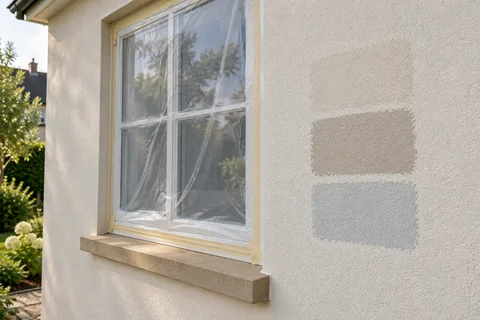
Mask glass, frames, sills, doors, roof edges, pipes and paving; cover cars and plants nearby.
Prime or stabilise any chalky, porous or previously painted areas the system requires.
Spray the first coat and back-roll it into the texture, then leave it to dry.
Apply the second coat, remove masking and cut in the edges by brush.
Choosing the coating
Use a coating made for render. K Rend's Colour Enhance is sold for existing rendered walls, old and new, on scraped and unscraped finishes. It goes on in two coats, the first diluted 10–15% onto a dry substrate and the second undiluted once the first has dried, after algae has been treated and all repairs carried out. K Rend's silicone masonry paint also goes on in two coats and should not be applied below 5°C or above 30°C.
MPA Mortar's rendering data sheet suggests cleaning with a fine jet of mains-pressure water, and says any cracks or damage come first, before the wash. On a wall finished in lime, use limewash or a breathable mineral paint rather than a standard masonry paint.
On a small terraced frontage, the render is seen beside brick, a door, window frames and the roof. Try a large sample on the wall itself and look at it in the morning and late afternoon before deciding.
Address checks and upkeep
Repainting a house is usually permitted development, but Hull City Council uses Article 4 directions to control particular alterations in certain areas, and the council's conservation pages identify the areas and their boundaries. Check the address before choosing a strong change of colour, particularly on a terrace where the houses were designed to read as a group.
Afterwards, keep the product name and colour code. Wash off green growth before it takes hold, clear gutters that overflow onto the wall, and recoat when the colour has faded rather than waiting for the coating to break down.
Common questions
Spray or roller?
Spraying gets coating into the texture quickly and evenly, and back-rolling works it in. Brush and roller are used near glass and edges, and in wind, where spray mist would drift.
Can I go darker?
Usually, if the coating is suitable for the colour. Ask the manufacturer about dark shades on your render, especially on a sunny elevation.
See housing and planning information for Hull and nearby places, including the source and geography behind each figure.